High Performance Learning
Every student has the potential to achieve highly. At St Benedict's, we have made a deliberate commitment to developing the thinking skills, values, and attributes that make this possible.
“The most successful learners are not born — they are made. And we know how to make them.”
Professor Deborah Eyre, Founder of High Performance Learning
What is High Performance Learning?
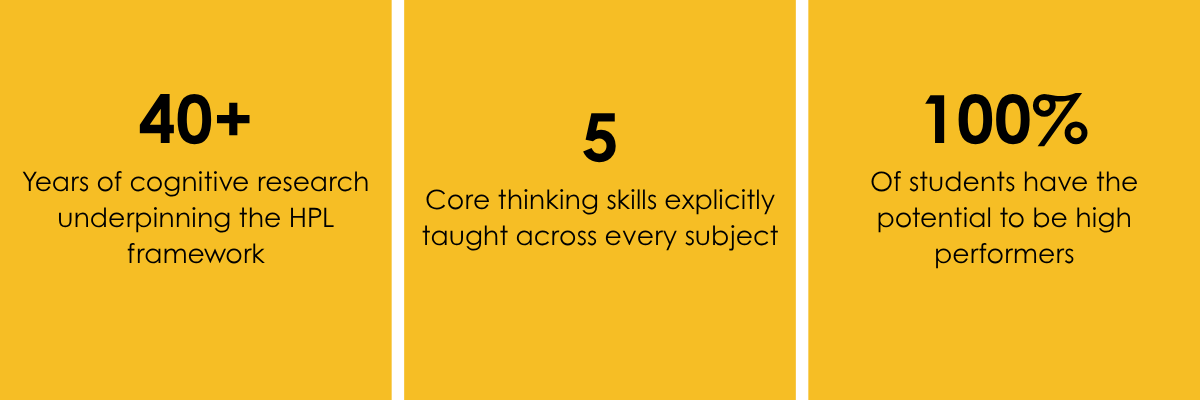
High Performance Learning (HPL) is a research-based, pedagogy-led philosophy founded by Professor Deborah Eyre, drawing on over 40 years of cognitive research. Its central premise is powerful and evidence-backed: high performance is not a gift reserved for the few. With the right environment, deliberate practice, and explicitly taught skills, every student can achieve at the highest level.
HPL provides schools with a practical framework to develop, systematically, the ways of thinking and the personal qualities that underpin lifelong success — not just in examinations, but in university, in the workplace, and in life. It moves beyond the traditional focus on knowledge acquisition to cultivate the how of learning: how students think, how they approach challenge, how they grow.
As an HPL Pathway School, St Benedict's is part of a global network of institutions committed to this vision — working toward recognition as a World Class School.
Why HPL? The Benedictine Connection
The values at the heart of High Performance Learning are deeply consonant with the Benedictine ethos that has shaped St Benedict's School for over a century. St Benedict's Rule calls for balance, perseverance, and the continuous formation of the whole person — ora et labora, prayer and work, reflecting a commitment to excellence through sustained effort rather than innate talent.
The Benedictine tradition values intellectual curiosity, humility, and community. HPL gives these timeless principles a contemporary educational language: resilience, collaborative enquiry, intellectual confidence, empathy, and the belief that growth is always possible. In joining the HPL network, St Benedict's is not departing from its roots — it is expressing them in the classroom, every day.
Ora et Labora
Hard work and perseverance as a spiritual and intellectual discipline.
The Whole Person
Formation of character, values and intellect, not just examination results.
Community
Collaborative, empathetic learners who contribute to the common good.
The Power of 'Yet'
A growth mindset rooted in humility and the belief that all can improve.
Two Dimensions of High Performance
The HPL framework identifies two interconnected dimensions that together create the conditions for high performance. Both are taught explicitly and developed systematically across all subjects at St Benedict's.
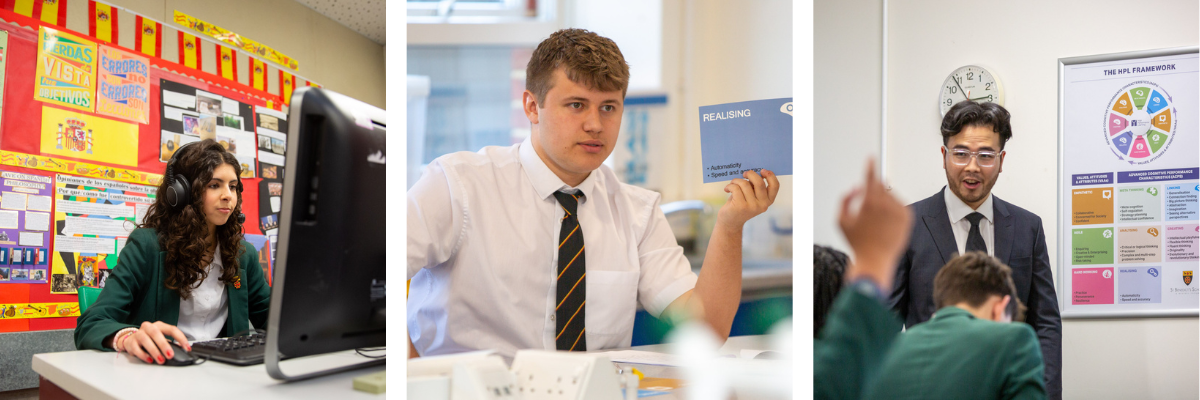
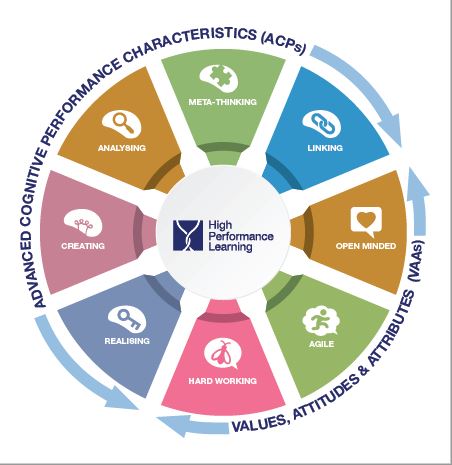
Advanced Cognitive Performance Characteristics (ACPs) are the thinking skills of high performers: meta-thinking, analysing, linking, creating, and realising. These are not innate abilities but learnable habits of mind, practised deliberately across every subject area.
Values, Attitudes and Attributes (VAAs) are the character qualities that enable and sustain high performance: empathy, agility, hard work, resilience, and collaborative confidence. Research shows these are every bit as important as cognitive skill — and every bit as teachable.
Together, ACPs and VAAs create learners who are not just academically capable, but genuinely equipped for the future.
HPL in the Classroom
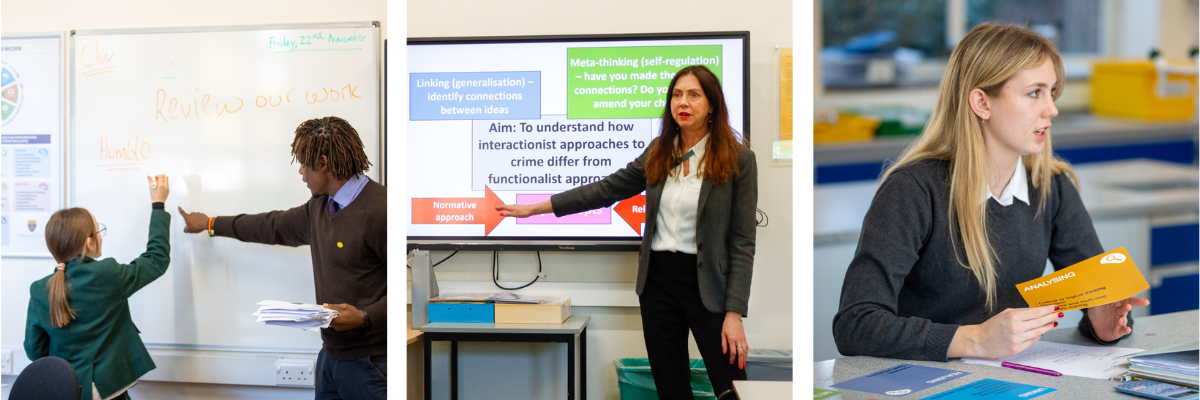
HPL is not a separate lesson or bolt-on programme — it is woven into the fabric of teaching at St Benedict's. Teachers explicitly name and develop HPL thinking skills through the lens of their own subject, making the language of learning a shared vocabulary across the school.
History · KS4
Identifying the Historian's Toolkit
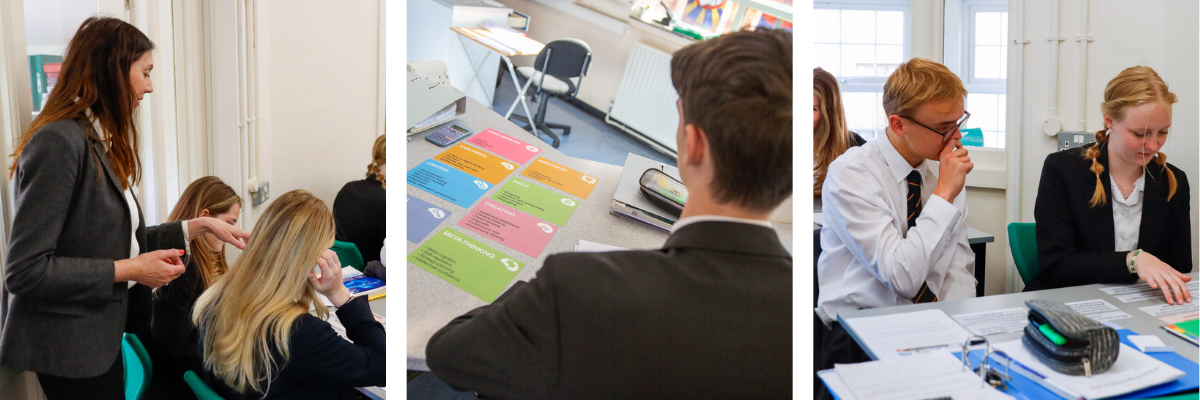
In a Year 10 History lesson on source analysis, Mr MacGinty used HPL skill cards to help students name the thinking skills they were deploying as historians — making the invisible act of historical reasoning explicit and visible.
Chemistry · Lower Sixth
Station-Based Skill Recognition
Miss Bartholomew set up four stations, each with a set of HPL cards. Working in pairs, students identified which thinking skills each activity demanded — building metacognitive awareness alongside subject knowledge.
Across the School
A Shared Language of Learning
Using the HPL language across all subjects helps pupils understand why they are doing what they are doing. Students consciously develop transferable thinking skills that will serve them throughout their education and beyond.
Science · GCSE
Thinking Skills Mapped to Assessment Objectives
GCSE Science objectives are directly aligned with HPL thinking skills: hypothesising maps to connection-finding; evaluating methods reflects flexible thinking; constructing reasoned arguments draws on intellectual confidence.
Thinking About Your Thinking
One of the most powerful HPL skills — and one with the strongest research base — is meta-thinking: the capacity to step back, reflect on your own learning, and make deliberate choices about how to improve.
At St Benedict's, we actively involve parents in supporting this skill at home. Our simple three-step framework gives families practical tools to nurture independent, reflective learners.

Our Vision
A World Class Aspiration
HPL schools share a compelling vision: that almost every student, regardless of background or starting point, should be able to achieve the highest academic standards — while also developing the values and attributes that will serve them in university, in work, and in life. St Benedict's is working toward the World Class Schools Award, a rigorous external validation of this ambition.